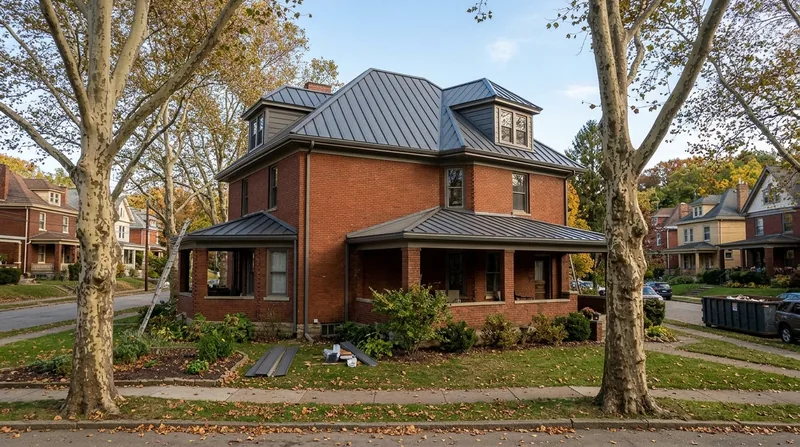




Standing seam metal roofing in Pittsburgh holds up to the freeze-thaw cycling, lake-effect snow, and summer hail that hammer roofs from Mount Washington to Cranberry. Our panels are roll-formed to length on site, then mechanically seamed or snap-locked so no fastener is exposed to back out. On the steep hillside lots above the Monongahela and Allegheny, that concealed-fastener design keeps panels tight through wind gusts that funnel up the river valleys. We install over 1880s brick row houses in Lawrenceville, steep-gable Tudors in Squirrel Hill, and newer subdivision homes in Wexford. If you are weighing this against a shingle re-roof, start with our metal roof installation overview and then call (412) 895-2157.
Why Standing Seam Metal Roofing Fits Pittsburgh's Hills, Snow, and Old Brick
Pittsburgh roofs take a beating that flat shingle roofs in milder climates never see. Lake-effect snow piles up, then melts and refreezes at the eaves, and that ice dam pushes water under shingles and into 1920s brick foursquares in Brookline and Dormont. Standing seam sheds snow faster on steep pitches, and the raised seams break up ice sheets instead of letting them creep. On the city's narrow hillside lots, panels cut to length mean fewer horizontal laps where water can sit.
- Concealed fasteners eliminate the screw back-out that plagues exposed-fastener panels under constant freeze-thaw.
- Mechanically seamed panels resist wind uplift on exposed ridge lines in Mount Washington and the South Side Slopes.
- Kynar 500 finishes hold color under Pittsburgh's low grey skies and humid summers better than painted exposed-fastener panels.
- Panels span steep gables on Victorian and Queen Anne homes where shingle courses would need extra underlayment.
- The smooth surface sheds sugar maple leaves and sycamore seed balls that trap moisture on shingle roofs.
For homeowners replacing slate or tin on older city homes, standing seam gives a period-appropriate look with modern weather resistance. Verify permit requirements with the City of Pittsburgh Department of Permitting, Licensing and Inspection before any full replacement, since thresholds and inspection rules vary by jurisdiction.
Key info: A Shadyside homeowner with a 1920s slate gable replaced failing slate with 24-gauge standing seam in a dark bronze finish. The panels were roll-formed in the driveway and seamed on the roof, which avoided crane access on a narrow side lot.
How We Install Standing Seam on Pittsburgh Roofs
Every standing seam job starts with a tear-off and deck inspection, because Pittsburgh's older homes often hide rotted sheathing under three layers of shingles. We measure the roof on site, order coil in the finish you pick, and roll-form panels to exact length so there are no end laps. On steep hillside roofs we set staging and roof jacks carefully to protect landscaping and retaining walls below.
- We strip the old roof to the deck and replace any soft or delaminated sheathing we find.
- We install ice and water shield at the eaves and in valleys, which matters on Pittsburgh roofs that see repeated freeze-thaw.
- We set the underlayment and then the panel layout, keeping seams aligned with the ridge and eave lines.
- We roll-form panels to length on site and lift them without dragging them across finished seams.
- We mechanically seam or snap-lock each panel, then install ridge caps, closures, and pipe boots.
- We flash chimneys and skylights with formed metal, not caulk, and test every penetration with water before we leave.
The result is a roof that stays watertight through Pittsburgh's summer thunderstorms and winter ice without annual screw checks. See our Bethel Park standing seam page for a local example of how the process runs on a typical suburban ranch.
Key info: On a steep Mount Washington roof overlooking the Monongahela, we staged panels on the uphill side and used roof jacks rated for the pitch. The homeowner wanted no crane on the narrow street, and roll-forming on site kept the panels under 24 feet.
Standing Seam Approaches We Use in Pittsburgh
The right panel profile depends on your roof pitch, your budget, and whether the home sits in a historic district or HOA with design review. We install several standing seam systems and match the seaming method to the roof, not the other way around.
| Approach | Description | Best for |
|---|---|---|
| Mechanically seamed | Panels joined with a raised double-lock seam using a powered seamer. | Steep gables and exposed ridges on Squirrel Hill and Mount Washington homes. |
| Snap-lock | Concealed fastener panels that snap together without a seamer. | Porches, additions, and lower-slope sections where access is tight. |
| 24-gauge steel | Heavier gauge for wind and hail resistance in Allegheny County storms. | Whole-house replacements in Cranberry and Wexford subdivisions. |
| 26-gauge steel | Lighter gauge panels with the same concealed-fastener design. | Budget-conscious retrofits on Cape Cods in Penn Hills and Brookline. |
| Copper and specialty metal | Standing seam in copper or zinc for period-correct historic work. | Victorian and Queen Anne homes in Lawrenceville and Bloomfield. |
Each system carries the same benefit: no exposed screws and a seam that stays tight through Pittsburgh's weather swings.
Standing Seam Metal Roofing Cost in Pittsburgh: What to Expect
Standing seam pricing starts from $10 per square foot installed, and that figure moves with gauge, finish, roof complexity, and access. A simple gable ranch in Bethel Park sits at the low end. A steep Victorian with multiple valleys, dormers, and a narrow hillside lot in the South Side Slopes lands higher because of staging, panel length limits, and flashing detail. Copper and specialty metal run well above steel.
Tree cover matters too. Homes under mature oaks and tulip poplars in Highland Park need debris cleared from valleys and gutters before panels go on, and that prep adds labor. Getting two or three written estimates lets you compare gauge, finish warranty, and seam method, not just the bottom line. Our full pricing overview breaks down the ranges by panel type and roof pitch.
What to Look For in a Standing Seam Metal Roofing Contractor Near Me in Pittsburgh
Standing seam is a specialty install, and not every roofer who hangs shingles has a seamer or the training to run one. Ask for proof of licensing and insurance before anyone walks your roof, and get the certificate sent to you directly. Ask how many standing seam roofs the crew has completed in Allegheny County and whether they roll-form on site or order pre-cut panels. Check references on homes similar to yours, especially older brick or steep-gable roofs.
Confirm who pulls the permit. The City of Pittsburgh and surrounding boroughs require permits for full replacements, and historic districts and HOAs can restrict panel profile and color. Get the scope in writing, including underlayment, flashing, and snow guards, then compare. Reach out through our contact page to schedule a free estimate at (412) 895-2157.
Standing Seam Metal Roofing in Pittsburgh: Pricing Guide
| Service | Price | Details |
|---|---|---|
| Standing seam installation, simple gable | Starting at $10/sq ft | Includes tear-off, underlayment, 26-gauge panels, and standard flashing on an accessible roof. |
| Standing seam installation, complex roof | Starting at $14/sq ft | Covers dormers, valleys, and steep pitches; price rises with staging difficulty and panel length limits. |
| 24-gauge upgrade | Add $1.50 to $2.50/sq ft | Heavier steel for hail and wind resistance; adds cost but improves dent and uplift performance. |
| Copper or specialty metal | On estimate | Material cost and seaming detail vary widely; an on-site look is needed before quoting. |
| Travel | Included | In Pittsburgh and surrounding areas, no separate call-out or mileage fee. |
| Estimate | Free | Response within 24h at (412) 895-2157, no obligation to book. |
Indicative pricing, the exact cost depends on square footage, finish, and site access. Free personalized estimate within 24h at (412) 895-2157.


